Beltane Annual Event June 2016

It was annual gathering time for the Beltane Public Engagement Network on Monday night http://www.beltanenetwork.org/ and Tirion and I headed along to talk about and show some of the research we have been doing so far.  We had a great night, drank smoothies, and talked to interested and interesting people. Here is our spot (spot the last packet of ‘Love heart sweeties’ most of which I ate):


Talk about liking to attract attention:
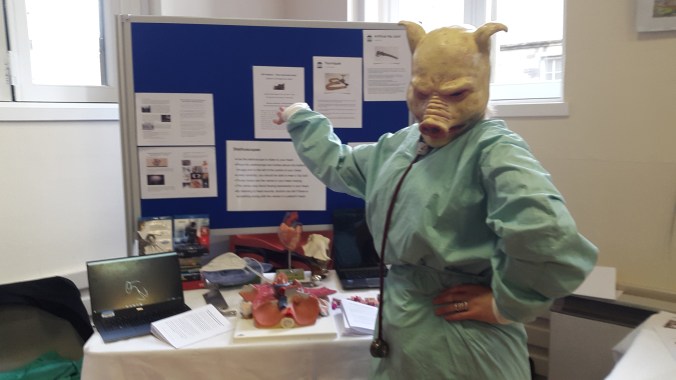
20160606_175738

Gill’s Pig-ME impression….

Annie Downie, Learning Officer at Surgeon’s Hall museum loaned us a few artefacts such as prosthetics and heart models https://museum.rcsed.ac.uk/plan-your-visit/learning.  I took these down to Ali Grant who will show some of the artefacts to the young people thinking about taking part in the production of In-Valid You/th. We also showed Maggie’s ICD Story and a sneak preview of ‘Electrifying the Cyborg Heart’ (which is being entered into Pariscience) and produced several leaflets:

PROJECT1: CODI

Book your tickets for Gill Haddow’s ‘One-stop-body-shop’. Cabaret of Dangerous Ideas, Sunday 28h August 2016 @ 3pm – 4pm, Cost – £8 (concession £6)

http://codi.beltanenetwork.org/event/codi-2016-one-stop-body-shop/

Please! Come in and browse. You can choose from a range of options for the repair and replacement of organs. Currently, I have several to offer you; human organs from deceased or living donors are all the rage nowadays but, yes, supplies are limited. I can show you the very latest, more expensive option of ‘grow-your-own’? 3-D bioprinting too pricey for you? Organs from genetically modified non-human animals can come in quite a bit cheaper. No. Sorry. We don’t do organic options. You’re vegetarian? I would recommend the cybernetic options (a delivery next week will replace faulty stock). So what will it be?

PROJECT2: ELECTRIFYING THE CYBORG HEART, MAGGIE’S ICD STORY, AND EVERDAY CYBORGS: A STORY ABOUT BODIES IN PARTS (IN PRODUCTION) 

‘Electrifying Cyborg Heart’ is a two minute animation based on the separation of self/body and subject/object playing on the cultural iconography and scientific representation of the heart. It outlines how both the body and the self, come to accommodate the alien implant (implantable cardiac defibrillator). Cameron Duguid is the animator and used a light box technique http://www.cameronduguid.co.uk/.  Maggie’s Story’ is approximately 3 minutes long. It shows Maggie, newly implanted with an ICD, writing about the various emotions, inner dialogue and other people’s reactions to her, on a variety of different backgrounds (Letters, diaries, appointment cards, ECG readings etc). She is sharing with an audience how it feels to be an ‘everyday cyborg’. The film-maker Ross Ziegelmeier used stop-motion animation (for an example of his work see https://vimeo.com/user25397788/videos). 

Everyday Cyborgs: A story about bodies in parts (in production) and Ross and I are thinking it might be an animated film that will be in 5 sequences and is based on the different stages of the cyborgisation process that starts with the implantation of a cybernetic device – ICD. This will be a collage effect showing how a body/person as composite parts that could draw upon who they were, what they did, where they live before telling the cyborg story through 5 different scenes:

  1. BECOMING CYBORG
  2. AFTER SURGERY: IN BUT NOT GONE
  3. THE SHOCKING TRUTH; IT’S THE FAULT OF ME OR THE ICD
  4. SURVIVING A STORM
  5. ALTERED SUBJECTIVITES AND TEMPORAL ADJUSTMENTS


PROJECT3: IN-VALID YOU/TH 

Currently underway, the public engagement project, called ‘In-valid You/th’ will allow a handful of teenagers to make their own 8 minute film about the fictional experiences of young people whose bodies have undergone repair or replacement with prosthetics or implants (for example, Josh Cathcart, aged nine years recently became the youngest recipient of a ‘Touch Bionic’ hand http://www.bbc.co.uk/news/uk-scotland-34015893).  Creating a film about individuals who may have faced stigma due to apparent physical disadvantages, may resonate with the structural constraints of living in Muirhouse. The chronic economic deprivation of the lived environment requires repair, replacement and regeneration in a similar way that some young people’s bodies may do. The views of the ‘digital citizens’ born in the internet age, are key to exploring how future bionic technologies will be received, given current social and ethical issues about implanting devices and prosthetics.

The participant-actors will 1) benefit directly from learning about the film making process through the support of directors, animators and musicians and 2) gain self-confidence through the completion and dissemination of the outcome and 3) by challenging themselves about stigma of physical difference create opportunities to challenge prejudices about health and wealth (e.g. the ‘undeserving poor’). We have already visited Scottish Electronics Centre and the Edinburgh Royal Infirmary Cardiology Department. Visits to the 3-D Bioprinting Laboratory as well as a Dissection at Old Surgeon’s Hall is planned.  


PROJECT4: ANIMAL, MECHANICAL AND ME: THE SEARCH FOR REPLACEABLE HEARTS. 

The contemporary need for naturalness can be better understood as a response to the fact that technology makes reality more and more makeable and, consequently, more contingent. Advancing technology changes everything that is, into our object of choice…[I]f human nature itself becomes makeable, it can no longer naively be laid down as the norm (Swierstra, Van Est, & Boenink, 2009).

The social science project aims to explore patient experiences and public reactions to using material from non-human animals or from auto-biotechnologies to repair, replace or regenerate the human body. It asks the question that “If you had to make the choice would you choose to have your organs replaced with animal or mechanical ones?” Does having parts of your body replaced with materials from other sources make you feel any different? By looking at what is currently repaired and replaced we can also learn about what to expect in the future. This research will undertake a sociological investigation into current practices of repairing and replacing the human heart specifically by interviewing ‘everyday cyborgs’ – those people who have received a cybernetic device called, an implantable cardioverter-defibrillator (ICD). It also seeks to understand what people preferences are when it comes to replacing or repairing their organs with regenerated bio-organs or prosthesis and cybernetic technologies. Studying the heart allows us to consider the intersection between medical science, embodiment, and identity. The repair, replacement or regeneration of tissues and organs can help unearth some of our deepest held beliefs about what humans being are and what being human is.

Trigger’s Broom from an episode of ‘Fools and Horses’.  

In the episode “Heroes and Villains“, Trigger wins an award for having owned the same broom for 20 years. He reveals that it has had 17 new heads and 14 new handles, but insists it is still the same broom; this is an example of the Ship of Theseus paradox. This has given rise to the expression “Trigger’s broom” (Source Wikipedia.com)


Coming soon – an original short story from Pippa Goldschmidt

Post by Tirion Seymour

There will be an exciting addition to the blog in coming weeks. The writer Pippa Goldschmidt, currently a visiting fellow here at the Science, Technology and Innovation Studies department at the University of Edinburgh, has kindly agreed to write a short story for the blog around medical devices.

Keep an eye out for Pippa’s work. You can check out her website and her previous work at http://www.pippagoldschmidt.co.uk/

Attending the 3D Bioprinting workshop at the Brocher Foundation

By Tirion Seymour

Geneva

Gill and I are lucky enough to be attending a workshop this week in the Brocher Institute on Lake Geneva based all around the topic of 3D bioprinting. This workshop brings together academics from science and social science interested in different aspects of this emerging technology, including current scientific developments, and the potential ethical and legal issues that might arise:
http://www.brocher.ch/en/events/223/3d-bioprinting-a-new-medical-and-ethical-frontier

We will be tweeting while in Geneva, and reporting back after, so keep an eye on us here and at our Twitter presence@AMandMe .


Poeming for Cabaret of Dangerous Ideas!

So I am presenting the One-Stop-Human-Body-Shop at CODI in August (excited? nervous!). See here if you want to buy a ticket  https://edinburghfestival.list.co.uk/event/578417-one-stop-body-shop/. Meantime in order to get the gist of the dangerous idea I will be proposing for my OSHBS here is a poem. Its based on my understanding that the last word in most of the sentences needs to rhyme. Yeah. I know. Wont be giving up the day job. Here goes:


‘Pigs and machines” v1


In a future I can see,

A special way of being human for you and me,

You see the longer we live for, the more we are going to need,

Organs that are broken and diseased, indeed

All of the things in the visceral space we know nothing about

Until we know these parts are things

We simply can’t do without.


Prosthetics are supports for the limbs and joint,

But they cannot replace whole organs,

not at this point,

Organ replacement needs human donors,

Donating body parts after brain dead,

Apart that is,

From their head.


Pigs – well there’s load of them for a bacon butty

So there is no need to make a fuss

Like a vegetarian,

Using parts of them to replace parts of us.

Indeed, spare heart valves can be porcine

And no one cares whether this is ethically “out of line”,

The next step then is a pig heart – and heh! its all fine.


But what is that you say?

You might not feel that great

Using for organ replacement an animal that you ate

It might make you want to oink, and roll in the mud,

Can you imagine the state?

Of identity befuddles with pig-human muddles.


Try instead a machine – much cleaner than an animal host,

Really the benefits of IT has so much more to boast,

Turning a person into a cyborg half human and half machine

Would make us all much more keen,

To live a hybrid life in-between

The question of where metal stops and I begin…..

A small detail to be ignored at the cost of a ‘what-might-have-been’.

Visiting cardiology!

Friday 21st April

So yesterday the In/Valid Youth squad descended on Edinburgh Royal Infirmary and got to meet Debbie (Head of Cardiac Physiology). She spent time with us talking about implantable cardiac defibrillators and showing us some demo ICD systems. We took some photos so Ali can take them back to show the young people; it’s really inspiring.   For some reason I have ‘zips’ written in my notes….

_MG_6575_MG_6590

Level Up Human

Gill Haddow

Friday 8th April 2016

I don’t get out very often (as most people I know will agree with) but last night I went to an event at the Edinburgh International Science Festival called ‘Level Up Human’.  Simon Watt (President of the ‘Ugly Animal preservation society’ http://uglyanimalsoc.com/ ) does a fantastic job of helping the panellists and audience think about what it would mean if ‘evolution was prodded;’ that is, with a little bit of extra help from xeno- or cybernetic enhancements.  It was a light-hearted look and so the two panellists Eli Sheppard – studying brain-computer interfaces and automatic speech recognition (http://www.edinburgh-robotics.org/students/eli-sheppard and Michael Wheeler,  a philosopher, http://www.hdc.ed.ac.uk/prof-michael-wheeler were invited to pitch to Gemma Flynn comedienne and criminologist (http://www.law.ed.ac.uk/people/gemmaflynn) so that she could choose her favourite ‘level up human’.

Despite the winner being a language chip for pets; other proposals included night vision (for environmental reasons); implantable nano-bots; additional limb prosthetics to reach the items on the supermarket top-shelf or synaesthesia-type vests so that you can feel what is being said to you.  I enjoyed the evening; what was not to like?  It was fun, light-hearted and not to be taken too seriously although issues such as gender inequality, data security, consent, interpretation and translation, and the Turing test were actually all in there.

Tweet your ideas for levelling up to @LevelUpHuman

The In-valid You/th project and interesting issues to think about: 3D printing and medicine

Post by Tirion Seymour

The In-valid You/th Project is part of a wider project called ‘Animal, Mechanical and Me: the Search for Replaceable Hearts’, which looks at the different ways that we might repair or replace parts of the human body: https://animalmechanicalandme.com/. The young people involved in making the film for In-valid You/th will be thinking about this topic and the experiences of people who live with mechanical, donated or artificial body parts or limbs.

The last few years have seen many scientific advances when it comes to the ability to make therapeutic interventions that are tailored to individual patients. One of the areas of technology that is getting lots of media attention with relation to medical uses is the area of 3D printing. This involves using machines that often look like advanced versions of ‘2D’ printers that are currently used to print words onto paper.

In 3D printing, a computer moves a printer arm in a precise way to build a model layer by layer following a specific design made on computer modelling software. For many objects that can be ‘3D printed’, the material being used in the place of ‘ink’ is often a form of plastic which hardens as it is layered. In non-medical areas, 3D printing has been used to create everything from toys, to food, to houses. The video below features some very interesting examples of 3d printed objects:

In the medical world, there are already many areas in which 3D printing using plastics and similar materials is already having an impact. One area has been in the development of usable prosthetic hands using this technology. A company called Enabling the Future has built a community of volunteers across the world interested in helping develop these tailor-made prosthetic hands for people in need of them, at a fraction of previous costs: http://enablingthefuture.org/about/.

Other uses of 3d printing for medicine have included the first skull transplant using a 3d printed skull: http://www.huffingtonpost.com/2014/03/26/3d-printed-skull-transplant-utrecht-_n_5036665.html. 3D printed objects have also helped the medical process in other ways, such as through the printing of detailed 3D models of parts of the body for educational purposes http://3dprint.nih.gov/about/medicine.

While the printing of plastic or synthetic medical devices is one application for this 3D printing technology, there is also research underway about the feasibility of printing biological human tissues such as cells and even the fabrication of whole printed organs. A BBC article published in just February of this year talked about the first 3D ‘printing’ of body parts in a lab in the USA: http://www.bbc.co.uk/news/health-35581454 Scientists have so far had success in growing these tissues in the lab, but are not yet at the stage of implanting these living tissues into a person. Researchers across the globe are exploring how we might get closer to this goal of producing tissue and organs usable for transplant. Scientists Dr Shu and Dr Faulkner-Jones here in Edinburgh at Heriot Watt University have themselves been hailed as ‘bioprinting pioneers’. They have had success in developing human organ bioprinting techniques using special gels made of synthetic DNA: http://www.scotsman.com/news/3d-printing-of-organs-for-transplant-step-closer-1-3686872. The social scientists Dr Gill Haddow and Dr Niki Vermeulen, along with myself, are working with them to understand the development and implications of this emerging technology.

Much of the research discussed above might seem closer to sci-fi ideas to some, but is already being developed in labs around the world. This will give the In-valid Youth team lots to think about when considering the different types of implants or prosthetics from a range of sources. Will we get to a stage where we can ‘mould’ our own mechanical or plastic limbs or organs? How would we want these to look if we could? If we could ‘grow’ what we needed out of human tissue, what would this be like for patients? In future weeks we will be exploring many issues around these kind of questions.

We will be returning to the topic of 3D printing and bioprinting in this blog in future weeks. In the meantime, if you want to listen to more on this topic, BBC Radio 4 last year produced a short radio documentary on ‘bioprinting’, accessible at the following link: http://www.bbc.co.uk/programmes/b05pn3t4

The sounds of the In-valid You/th project, continued….

In last week’s post (https://animalmechanicalandme.com/2016/03/10/the-sounds-of-the-in-valid-youth-project/) we introduced an initial track to set the scene for the In-Valid Youth film project that had been put together by the sound artist on our team, Patrick Walker.

You can find out more about Patrick and the rest of the team here: https://animalmechanicalandme.com/in-valid-youth/meet-the-in-valid-youth-project-team/

Below, Patrick shares some insights on the fascinating process behind developing such a track:

Initial experiments – Patrick Walker

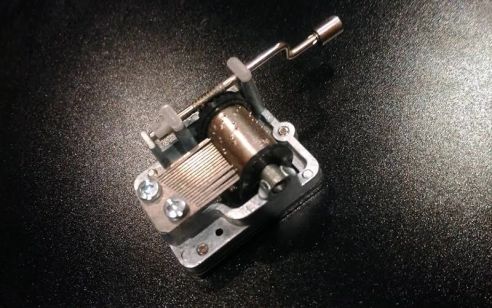
After setting up the studio to work on this project, I decided to look at some toys and little gadgets, the smaller the better! The first thing I picked up is a tiny music box which when you turn the handle plays the theme tune for the pink panther. For such a small machine, it produces a very haunting tone which is delicate yet resonant.

Music box

It’s quite a fiddly little device to record, but after experimenting with different positions, I found an angle where I could turn the handle without interrupting the sound of the recording.

After recording the sounds, these were split into individual tones, the eventual goal will be to make a virtual instrument, based on the tones of the music box, allowing us to create new melodies from scratch but for now, I contented myself with simply selecting some notes which could be recombined to make a simple melody.

I did not allow myself too much time to do this. At this stage, the last thing I want to do is get too caught up in creating whole tracks so as soon as I had something which resembled a loop-able melody, I decided to move on to other sounds.I started by dialing up some old things I had recorded, a toy robot – again perfect for the theme of cyborgs and how to make them more friendly.

After a while, I’d recorded and selected a number of sounds, mostly clockwork whirring and clicking. These sounds were then combined with previous sounds that I had used for the last Wellcome Trust project along with selected sounds from my archive – Hard Drives Booting up, Typing and the sounds of old dot-matrix printers (which were used for the introduction to our final video).

This gave me a range of appropriate sounds which I then programmed into one long section, adding little micro-edits here and there, panning the sounds around and experimenting with the use of a soft chorus plug-in to try and make the sounds a little less harsh and a bit more modulated sounding (in turn becoming more humanised and less rigid).

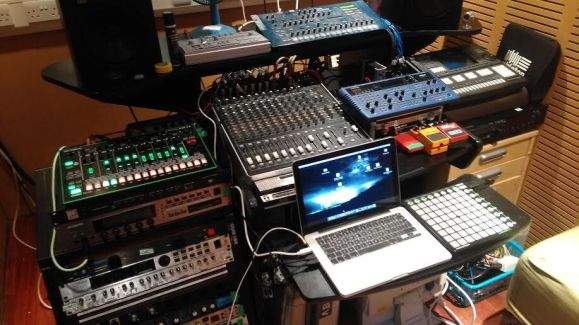
recording studio 2

This is something which again I started to play around with concept-wise, not only thinking about how to make machines sound more humanised but how to go the other way – and for this reason there were a couple of little squelchy sounds which were edited in such a way that they ended up sounding more like intricate motors. I then overlaid some of the machine textures with the initial sound of the music box and then added some white noise and very simple textures to fill in some spaces.

The final sketch I have created is very simple, and at the same time, authentic in the sense that it’s all made from delicate little machines as opposed to becoming more synthesised, arranged or produced. Although it’s designed to be a showcase of sounds, I feel that it does retain some musical value, the tones are very haunting.

The sounds of the In-valid You/th project

Today we bring you an early sound ‘mood board’ by our sound artist in the In-valid You/th project team Patrick Walker – https://animalmechanicalandme.com/in-valid-youth/meet-the-in-valid-youth-project-team/

Other examples of work by Patrick and others for North Edinburgh Arts are available here: https://soundcloud.com/north-edinburgh-arts

Below are some thoughts from Patrick about beginning work for this project:

Inspiration and initial creative thoughts – Patrick Walker

For this project I intend on a slightly different approach from the last projects that I have worked on. As opposed to going in deep with mood pieces and lots of different musical ideas right from the off, this time I’m focusing on micro-detail and creating a sound-palette to work with.

Detail is definitely something I want to get into this piece with lots of tricky programming, pretty, evolving melodies and unusual sound textures.I am taken with the notion of portraying a softer side to mechanisms and have been experimenting with recording and reproducing micro textures from interesting objects.

A couple of inspiration pieces I have been listening to are linked below :

Wauvenfold -Ji-Gad

The tricky, scattery and mechanical feel of this piece always makes me think of delicate machinery and the juxtaposition of the delicate melody with the skeletal beats touch on the notion I have to convey the mechanical in a more humanised way.

Bjork – All is full of love – Funkstorung remix

The video by Chris Cunningham married with Funkstorung’s excellent sound design speaks for itself, the marriage of machine and human is haunting and a little disturbing but also has this juxtaposition of skeletal, whirring, clicking beats overlaid with a powerful and soulful vocal.

Although both of these pieces are electronic and experimental, I am drawn towards the fact that there is still a softness and humanity being portrayed, albeit in quite an avant-garde way. I am also drawn to the fact that both of these tracks marry organic textures with mechanical. Finally I think both of these tracks span a range of emotions and moods from haunting, unusual and remote to warm, close and upbeat / positive.

Whilst listening to these tracks I reflected on my thoughts from the first project meeting. There was discussion on making technology more palatable and how to combat issues of isolation or alienation when considering gifting humans animal or synthetic parts. This sparked a lot of thought about how I might make a robot or cyborg be or feel more human or more accepted and so both of these tracks immediately popped into mind.

Looking at films such as Wall-E and R2D2 are a great example of how sound design can give personality and warmth to mechanical objects and again – this is something I have

been pondering in terms of potential techniques.

I’m also at the stage of simply bandying words and themes about, for example :
-Normality
-Change
-Fear
-Alienation
-Adaptation
-Always a solution
-Becoming something else
-Acceptance
-Embracing the future
-Self development

-Humanity

All of these words could be chained together into some progression where someone or some people go from a state of happy normality, through something life-changing

and disturbing, embracing change, adapting, surviving and then prospering. I’d like to take these words further and perhaps start to associate more words as building blocks towards themes or ideas which might help us define more of the narrative or similar.

Over the coming weeks, I will be experimenting with sounds which might be associated with some of these words of phrases. It’s an exercise I like to set students when they are learning the art of sound-design. The exercise is simply pick 5 colours and then tell me what sound you might associate with that colour – e.g.: yellow – the sun, the sound of frying bacon.

This will help me to build up a small library of textures or sounds which might fit with some of our potential themes in order that we have a bank of sounds to play with at the appropriate times.Furthermore, this gives us a range of sounds to use as inspiration when it comes to engaging participants – always good to have examples and ideas to get the creative juices flowing !


First team meeting

Tirion Seymour

Today we had a meeting of most of the creative team involved in the project (check out the ‘Meet the In-Valid You/th project team’ page to get to know us all.)

Everyone was excited to get going with the project. We were keen to set something up where young people could really play around with the ideas, and explore the different ideas around body part replacement and human enhancement. Films from the sci-fi genre often show either super-humans/ powerful human/machine hybrids, or characters outcast from society. In our project we will change the focus to what might be the actual realities of living as a cyborg?

There is also the technical side of the project that will involve the young people (and some of the less creative ‘academic’ members of the team!) having a complete introduction to ideas around film-making, animation, sound, story-writing and so on. This chance for young people involved to develop skills and confidence is a really important part of the project, and something that we will achieve using the well-established structures of the Muirhouse Youth Development Group, Screen Education Edinburgh and the Zoom Club. We will also bring in the creative talents of our animation and sound artists, who are already developing some ideas around the feel of the project’s theme.

The team are also hoping to get some inspiration through visiting some medical scientists at the cutting edge of regenerative medicine. There is a team based in Heriot Watt University involved with exciting activities involving the printing of cells using 3D printing techniques. Other scientists in the local area are involved with the development of mechanical devices to repair heart valves. Speaking to such experts, we hope, will give us a taster of the possibilities of biomedical technology that will help in firing our imaginations in developing the film.

We will be continuing to chart our progress throughout the whole project, so keep an eye out for us here and on Twitter!